The rise of remote work changed everything.
For the first time, millions of professionals were given the freedom to work from anywhere — no commute, no office politics, no rigid schedules. Working from home quickly became the default for entrepreneurs, freelancers, and remote employees alike.
At first, it felt like the ultimate upgrade.
But as months turned into years, a new question emerged — one that goes beyond convenience and comfort:
Which work environment actually supports long-term success?
Is working from home the sustainable choice?
Or do coworking spaces offer something deeper — something essential for growth, focus, and longevity?
The answer isn’t as simple as “one is better than the other.” Long-term success depends on more than productivity alone. It depends on structure, mindset, relationships, boundaries, and how consistently you can perform over time.
Let’s take a realistic look at both options.
What Long-Term Success Really Means
Before comparing environments, it’s important to define success beyond short-term output.
Long-term success includes:
Consistent productivity over years
Mental and emotional sustainability
Career or business growth
Strong professional relationships
Clear boundaries between work and life
Motivation that lasts beyond novelty
An environment that works for a season may not support you long term — especially as responsibilities grow and demands increase.
The Appeal of Working From Home
Working from home offers undeniable benefits — especially at the beginning.
Advantages of Working From Home
No commute
Maximum flexibility
Lower immediate costs
Comfort and familiarity
Easy integration with family life
For focused, independent work, home can be a powerful environment — particularly for people who:
Have strong self-discipline
Live alone or have minimal interruptions
Work best in complete quiet
Are in a short, intense work season
For many, working from home feels efficient at first.
The Hidden Challenges of Long-Term Work From Home
Over time, however, working from home can introduce challenges that slowly compound.
1. Blurred Boundaries
When your workspace and personal space overlap, it becomes difficult to:
Fully focus during work hours
Fully disconnect after work
Mentally “leave” work behind
This often leads to longer hours without better output — a common path to burnout.
2. Isolation and Motivation Drift
Humans are social by nature. Even introverts benefit from ambient social energy.
Working alone long-term can lead to:
Decreased motivation
Fewer spontaneous ideas
Slower problem-solving
Reduced sense of progress
Without interaction or shared momentum, work can start to feel stagnant.
3. Environmental Distractions
Home environments are filled with cognitive triggers:
Chores
Family needs
Comfort cues
Endless “quick tasks”
Even small interruptions break focus and make deep work harder to sustain day after day.
4. Professional Identity Erosion
When work happens exclusively at home, professional identity can blur.
Over time, this can affect:
Confidence
Momentum
Ambition
Perception of progress
Getting dressed, leaving the house, and entering a space designed for work creates a psychological shift that’s easy to underestimate.
What Coworking Spaces Offer Long Term
Coworking spaces are often misunderstood as simply “shared offices.” In reality, the best coworking environments are designed intentionally to support focus, structure, and professional growth.
Key Advantages of Coworking
1. Structure Without Rigidity
Coworking provides natural structure:
You arrive with intention
You work during defined hours
You leave at the end of the day
Unlike traditional offices, coworking doesn’t micromanage your time — but it does reinforce routine.
Long-term success thrives on rhythm, not constant flexibility.
2. Social Accountability and Energy
One of the strongest benefits of coworking is ambient accountability.
When you’re surrounded by others working:
Procrastination decreases
Focus lasts longer
Time blocks are respected
Momentum builds naturally
You don’t need constant interaction. Simply being around productive people changes behavior.
3. Clear Work-Life Separation
Coworking creates a physical boundary between:
Work mode
Life mode
This separation:
Improves focus during work
Makes it easier to disconnect afterward
Reduces burnout
Supports sustainability
Long-term success depends on recovery — not just output.
4. Reduced Decision Fatigue
Coworking environments remove friction:
Desk is ready
Wi-Fi is reliable
Tools are accessible
Space is optimized for focus
Fewer decisions before work = more energy for meaningful tasks.
5. Organic Collaboration and Growth
Coworking spaces offer something home offices can’t replicate: organic professional connection.
Over time, this leads to:
New ideas
Problem-solving conversations
Partnerships
Referrals
Emotional support
Growth rarely happens in isolation.
Productivity vs. Sustainability
Working from home can be productive in short bursts.
Coworking tends to be more sustainable over time.
Why?
It supports consistency
It reduces emotional fatigue
It creates external structure
It reinforces professional identity
Long-term success is about showing up well most days, not having occasional hyper-productive weeks followed by burnout.
Which Environment Is Better for Career Growth?
Working From Home Often Favors:
Short-term efficiency
Solo execution
Cost savings
Coworking Often Favors:
Skill development
Network expansion
Leadership growth
Creative momentum
If your goals include advancement, collaboration, or entrepreneurship, coworking provides long-term advantages that go beyond productivity metrics.
Mental Health and Emotional Sustainability
Long-term success isn’t just about output — it’s about mental well-being.
Extended isolation can contribute to:
Loneliness
Anxiety
Decreased motivation
Emotional exhaustion
Coworking offers:
Human presence
Community without obligation
Normalized work rhythms
Even minimal interaction can significantly improve emotional resilience over time.
The Hybrid Reality: The Best of Both Worlds
For many professionals, the answer isn’t either/or — it’s both.
A hybrid approach might look like:
Coworking for focused work, meetings, and momentum
Home for occasional deep solo tasks or flexible days
Structured days mixed with flexible ones
Long-term success often comes from adapting environments to changing seasons of life and work.
Signs Working From Home Is No Longer Supporting You
You may benefit from coworking if:
You struggle to start tasks
Your days feel scattered
You work longer hours with less output
Motivation feels inconsistent
You miss professional interaction
You feel isolated or stagnant
These aren’t failures — they’re signals.
Signs Coworking Supports Long-Term Success
Coworking is working when:
Focus feels easier
Workdays have rhythm
You finish important projects more consistently
You feel energized instead of drained
You’re growing — not just maintaining
Long-Term Success Is About Environment Fit
There is no universally “better” option.
The better environment is the one that:
Supports your energy
Reinforces focus
Encourages growth
Protects your well-being
Evolves with your goals
What works early in your career may not work later. What works during one season may need adjustment in another.
The most successful professionals don’t cling to convenience — they choose environments that support who they’re becoming.
Coworking vs Working from Home
Working from home changed how we think about work. Coworking is changing how we sustain it.
Long-term success isn’t about maximizing comfort or minimizing effort. It’s about designing a work life you can maintain — mentally, emotionally, and professionally.
Sometimes, the most strategic move isn’t changing your workload.
It’s changing where you show up to do it.
Cowork at The Blooming Desk
When comparing coworking to working from home, long-term success often comes down to sustainability. While working from home may feel convenient in the short term, many professionals eventually hit the same challenges: isolation, blurred boundaries, burnout, and declining focus. That’s where coworking spaces—specifically The Blooming Desk—offer a more sustainable path forward.
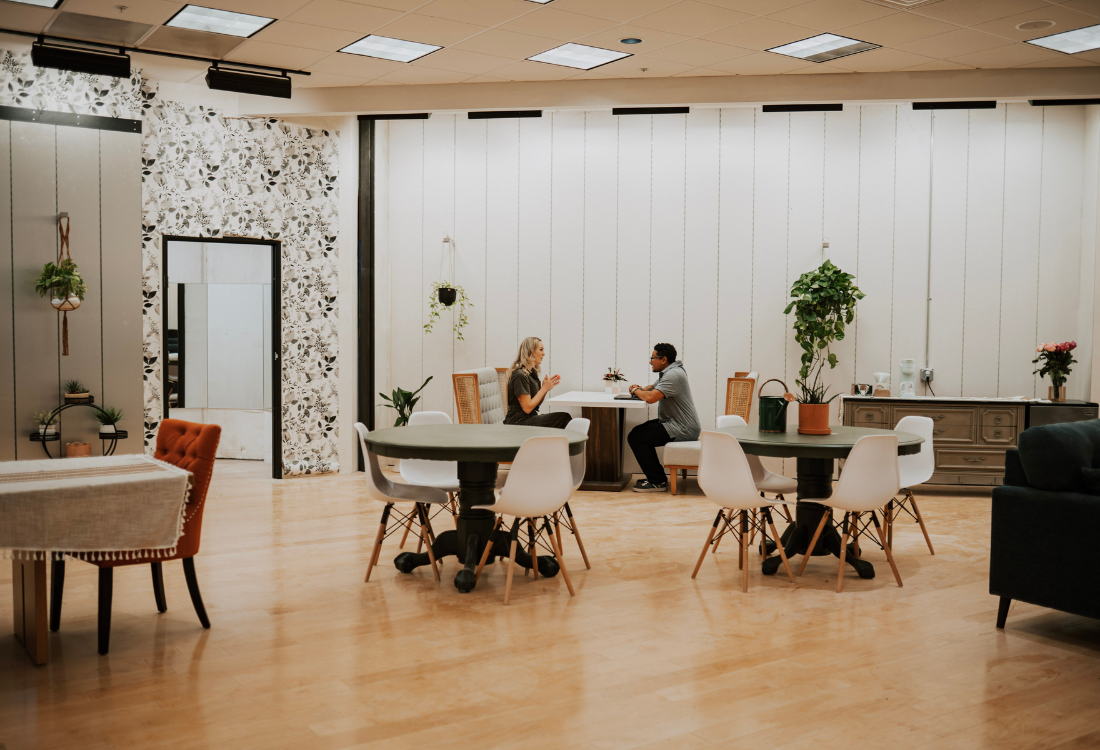
Located inside Salem Center Mall, The Blooming Desk was intentionally created for professionals who want structure without rigidity. It provides the separation that working from home often lacks—clear work hours, fewer distractions, and an environment that signals to your brain that it’s time to focus. Over time, this separation becomes essential for maintaining consistent productivity and preventing burnout.
Unlike a home office that can easily become another room full of distractions, The Blooming Desk offers a calm, professional setting that supports deep work, routine building, and mental clarity. Members can choose how they work best—whether that’s quiet solo focus, collaborative coworking, or stepping into community events that reignite motivation and creativity.
Long-term success isn’t just about getting work done today—it’s about building habits and systems that still work months and years down the line. Coworking spaces like The Blooming Desk help professionals establish healthier rhythms, stronger boundaries, and a sense of connection that’s often missing when working alone.
For entrepreneurs, remote workers, and creatives thinking beyond short-term convenience, The Blooming Desk represents more than a workspace. It’s a long-term investment in focus, balance, and a work routine that can grow with you—something working from home alone rarely provides.